 qproj wiki
xAIF editor
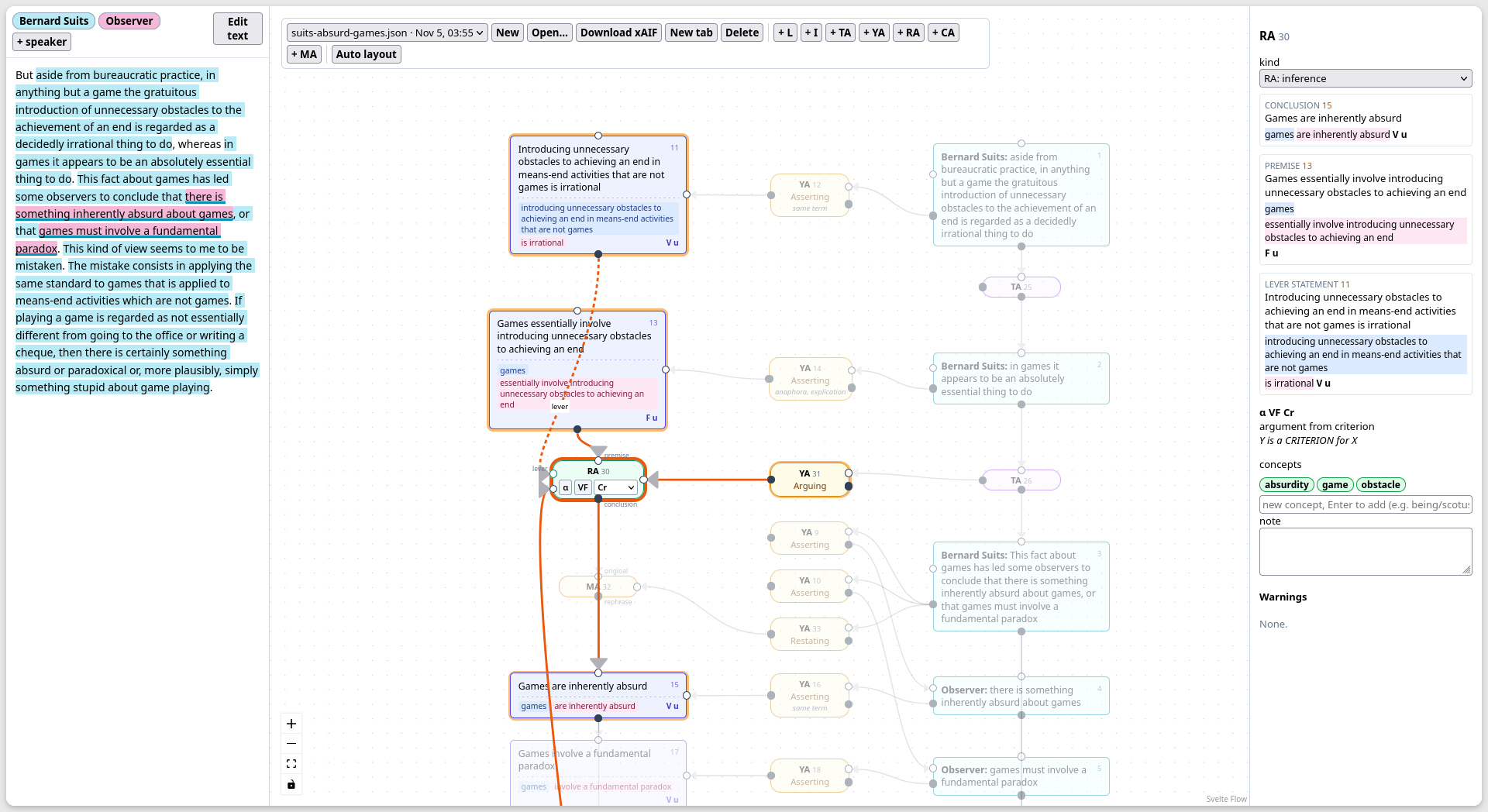
The xAIF editor is a lab for drawing and checking argument maps. It lets a person take a passage of philosophy, mark who said what, reconstruct the claims in plain canonical form, and link them into a graph that records which claims support or attack which. Each support link is typed with the Periodic Table of Arguments, and the editor works that type out itself.1
The NLP research it served is being dropped. The editor is kept because a structured, checkable model of an argument may still be useful elsewhere.
Why we built it
The debate idea needed gold-standard maps: hand-reviewed graphs that a game, or an automated analyser, could be measured against.2 The first labelling tool, INCEpTION, is a general annotation server. It could not enforce the shape of an IAT graph, and it could not derive an argument’s type from the statements it connects, so a labeller had to choose type codes by hand and mistakes went unnoticed.3
A purpose-built editor fixes both. It only allows connections that Inference Anchoring Theory permits, and it derives each inference’s type from its statements, so the only judgement left to the labeller is the lever. Reviewing a map then means reviewing the reconstruction, which is the part that needs a human.
What it gives us
- Format: maps are stored as xAIF, ARG-tech’s JSON format for argument graphs, with a few additions for the type data. See Argument maps for the model and the workflow.
- A log of interpretive decisions (
judgement-calls.md) that doubles as a draft labelling guide, so the same question gets the same answer next time. - A conformance file,
examples/ra-inputs.json, listing every way into an inference and the type it should derive. Any reimplementation of the rules can be tested against it. - A working check of the PTA procedure. Explaining why an inference gets its type is easier with the graph in front of you. See Periodic Table of Arguments.
See also
- Argument maps — the maps made with it.
- Research labs — the other labs, and the rules for texts that cannot be published.